
Royalty Ridge

Phone : (307) 463-7776

Owning mineral rights can raise an important question: Does your interest generate income today, or does its value depend mainly on future development?

That distinction helps explain the difference between producing and non-producing mineral rights. It can affect how buyers evaluate your ownership, what documents you need, and what questions to ask before considering an offer.

However, production status is only part of the picture. A producing interest does not guarantee steady income, and a non-producing interest is not automatically worthless. Understanding the property, ownership documents, and development activity gives you a stronger starting point.

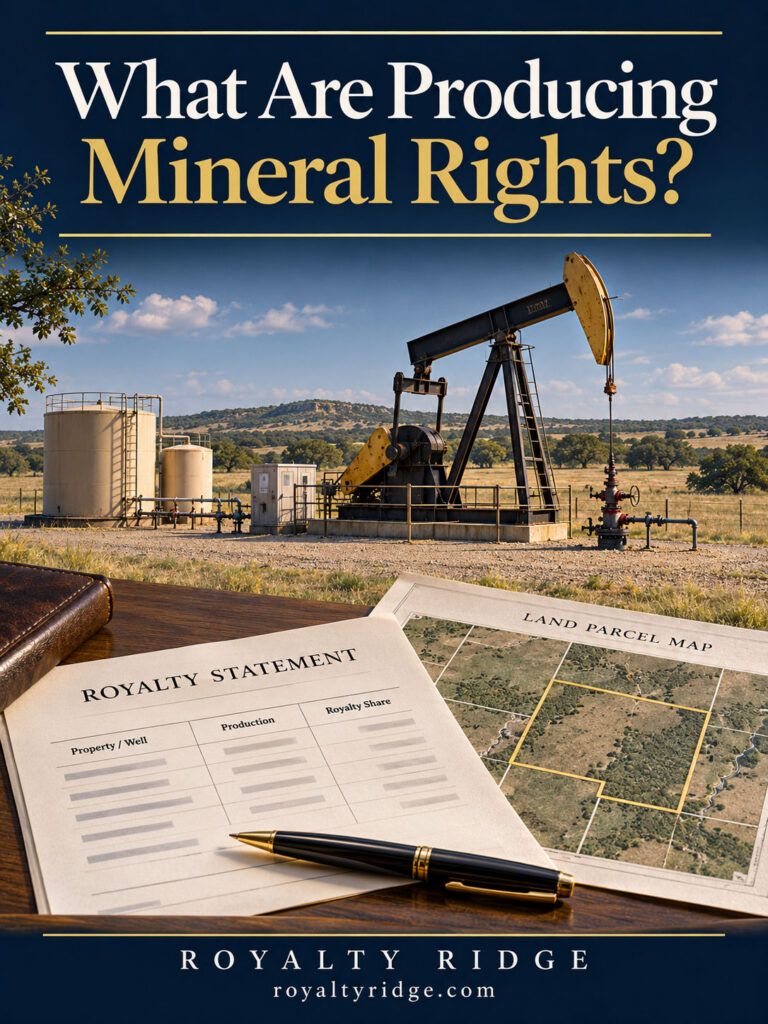
Producing mineral rights generally refer to mineral ownership associated with wells currently producing oil or natural gas attributable to that interest.

When an owner has leased those minerals and holds the corresponding royalty entitlement, production may generate royalty payments under the lease. Mineral ownership and royalty ownership are related, but they are not always identical: someone can own a royalty interest without owning the full mineral estate.

For an owner receiving payments, useful records include:

  • Royalty statements showing production periods and payment details.
  • Lease documents and amendments.
  • Division orders identifying the payment interest.
  • Well names, identification numbers, and operator information.
  • Recorded deeds and inheritance documents.

These records help explain what you own and which production contributes to your income.

Producing Does Not Mean Predictable

A royalty check should not be treated as a fixed salary. Payments can change as production volumes, realized prices, and applicable deductions change.

A larger payment in one month does not establish what the interest will earn next year. Reviewing a longer payment history provides more context than relying on a single recent check

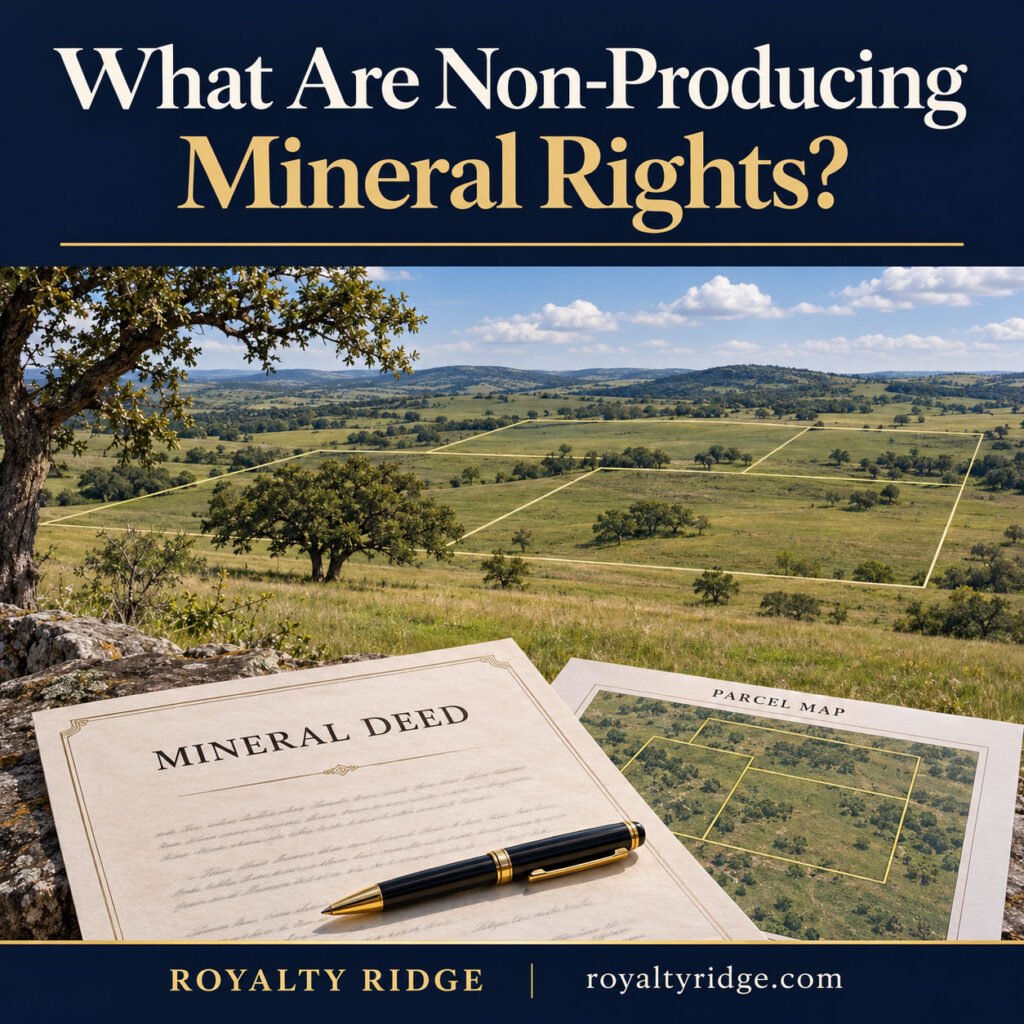
Non-producing mineral rights generally refer to mineral ownership with no current oil or gas production attributable to the interest.

Several situations can fall into this category:

  • The minerals have never been developed.
  • The property is leased, but drilling has not started.
  • A well has been drilled but has not begun producing.
  • Previous production has stopped.
  • Development depends on future infrastructure or operator decisions.

Leased and producing are different conditions. Signing an oil and gas lease grants specified development rights; it does not guarantee that a company will drill a well. The New York State Department of Environmental Conservation explicitly highlights this distinction in its landowner guidance. 

Non-producing ownership may therefore have an active lease even when it generates no production royalties.

#RoyaltyRidge #NonProducingMineralRights #MineralRights #MineralOwners #MineralOwnership #MineralValuation #OilAndGas #SellingMineralRights
Factor Producing mineral rights Non-producing mineral rights
Current activity
Production is attributable to the interest
No current production is attributable to the interest
Production royalties
May generate payments, depending on ownership and payment status
Generally no current production royalties
Can be transferred separately?
Production records and payment history
Geological information, lease records, and development activity
Evaluation focus
Existing production plus remaining development potential
Potential development, timing, and uncertainty
Key owner question
What supports the current income, and how might it change?
What evidence supports future development?

Both categories require property-specific research. The label alone cannot establish a fair purchase price.

Not necessarily. Production status and payment status are separate questions.

An owner may need to investigate a payment interruption before assuming that production has stopped. Start by contacting the operator’s owner relations department and asking which production periods were paid, whether funds are being held, and whether additional ownership information is required.

Check public production records separately. In Texas, owners can obtain reported production information through the Railroad Commission using relevant lease and location details. Those records help establish reported activity; they do not, by themselves, prove your ownership or the amount owed to you.

Keep a written record of enquiries and compare the operator’s response with your statements and ownership documents.

How Buyers Generally Evaluate Producing Interests

For producing interests, a buyer’s review commonly considers both existing income and what may happen next.

1. Production and Payment History

Historical records help identify whether income reflects sustained production, an unusually strong period, or a temporary adjustment. A useful review looks beyond the latest payment and considers the relationship between production volumes, prices, and the owner’s payment share.

2. Ownership Size and Scope

The evaluation should identify the exact interest involved, including its fractional ownership, covered acreage, relevant formations, and any limitations in the recorded documents. Two owners connected to the same property can hold different interests and receive different payments.

3. Lease and Royalty Terms

The lease helps establish the royalty entitlement and other provisions affecting the interest. Qualifying production may also continue a lease beyond its initial term, depending on the agreement and applicable law. NARO

4. Remaining Development Potential

Existing wells may be only part of the property’s story. A review may also consider whether additional development is supported by evidence. Potential future wells should remain clearly separated from wells already producing.

Without current production income, an evaluation depends more heavily on the evidence supporting future development.

Questions worth asking include:

  • Where is the property located?
  • What formations or depths does the ownership cover?
  • Is there an active lease?
  • Are nearby wells relevant to the same geological setting?
  • Are there permits or documented development plans?
  • Is infrastructure available?
  • What assumptions are being made about timing?

Nearby drilling can provide useful context, but it does not establish that your minerals will be developed.

An offer based on future activity should explain that uncertainty. Statements such as “drilling is coming soon” deserve supporting evidence.

There is no reliable rule that producing ownership is always worth more.

An interest with current income offers evidence that an undeveloped property may lack. However, a comparison also needs to consider ownership size, location, lease terms, production outlook, and development potential.

For example, comparing a small interest connected to older wells with a much larger undeveloped interest would reveal little without examining those differences.

Compare the assets and assumptions behind the offers—not just their production labels.

Documents to Gather Before an Evaluation

Preparing your records can make the discussion more useful.

Document or information Why it helps
Mineral deed or other recorded conveyance
Identifies the ownership transferred or reserved
Probate or inheritance records
Helps explain how ownership passed to you
Oil and gas lease and amendments
Shows the relevant agreement and terms
Recent royalty statements, if available
Provides payment and production-period information
Division orders
Shows the payment interest described by the payor
Legal description and property location
Helps locate the specific interest
Well and operator details
Connects the records to reported activity
Previous offers
Allows comparison of the proposed purchase scope and terms
Assuming Non-Producing Means Worthless :An absence of current royalties does not establish that an interest has no value. The question is what credible evidence supports its potential.


Assuming a Lease Guarantees Drilling :A lease and an operating well are different things. Review actual activity rather than relying on the existence of a lease.


Using One Royalty Check as the Entire Valuation:A single payment may not represent typical income. Review its production period and compare it with a broader history.


Comparing Offers for Different Interests :One offer may cover all your ownership, while another covers only a percentage, certain depths, or specified tracts. Confirm what each buyer proposes to purchase.


Overlooking the Difference Between Leasing and Selling :A lease grants contractual development rights. A sale transfers the interest described in the conveyance. Understand which transaction is being proposed before signing.

Before deciding, ask the buyer:

  1. What exact interest does this offer cover?
  2. How did you confirm its production status?
  3. Which records support the evaluation?
  4. How much of the offer depends on possible future development?
  5. Does the proposed purchase include all depths and acreage?
  6. What conditions could change the offer before closing?
  7. What documents will transfer ownership?

Clear answers make offers easier to compare and help expose assumptions that need further review.

Understand Your Ownership Before Your Next Decision

Producing and non-producing mineral rights present different questions. Producing interests require a careful look at existing income and its outlook. Non-producing interests require a close review of development evidence and uncertainty.

In either case, start with the same foundation: confirm what you own, understand the relevant documents, and examine the assumptions behind an offer.

Considering your options? Visit Royalty Ridge to discuss your mineral or royalty interest and request an evaluation.

This article provides general educational information. Ownership, lease interpretation, and transaction consequences depend on the documents and applicable state law.

Frequently Asked Questions

A royalty interest generally gives its owner a right to receive a share of oil or gas production or proceeds according to the applicable lease and ownership documents.

A royalty interest generally provides an economic interest in production without the same operational obligations associated with a working interest. A working-interest owner may bear applicable development and operating costs.

That depends on the nature of the underlying mineral and royalty interest and the applicable documents. Mineral ownership and royalty interests should not automatically be treated as identical.

A simplified calculation considers production volume, applicable price, and the owner’s royalty percentage. Actual payments can also reflect taxes, deductions, adjustments, and ownership fractions.

Payments can change because of production levels, commodity prices, deductions, taxes, adjustments, new wells, production declines, and other factors.

The Texas Railroad Commission provides reported production and permitting information through its online resources.

Scroll to Top