


Royalty Ridge

Phone : (307) 463-7776

How to Sell Inherited Mineral Rights: A Guide for Heirs and Families

Inheriting mineral rights can be unexpected. You may receive a royalty check in the mail, discover your name on an old mineral deed, or learn through an estate settlement that you own an interest in oil and gas beneath a property.

Then the questions begin:

  • What exactly did I inherit?
  • How much are the mineral rights worth?
  • Can I sell inherited mineral rights?
  • Do all of the heirs have to agree?
  • What documents do I need?

These questions are common because inherited mineral rights can be very different from ordinary inherited property. Ownership may be divided among several family members, records may span multiple generations, and the minerals may be producing, non-producing, leased, or subject to an existing royalty arrangement.

At Royalty Ridge, the focus is helping mineral owners understand what they own, evaluate their interests, and understand their options before making a decision. The company says it works with families sorting through estates as well as owners who may not have complete or current paperwork.

This guide explains the process of selling inherited mineral rights and the issues heirs should consider along the way.

What Are Inherited Mineral Rights?

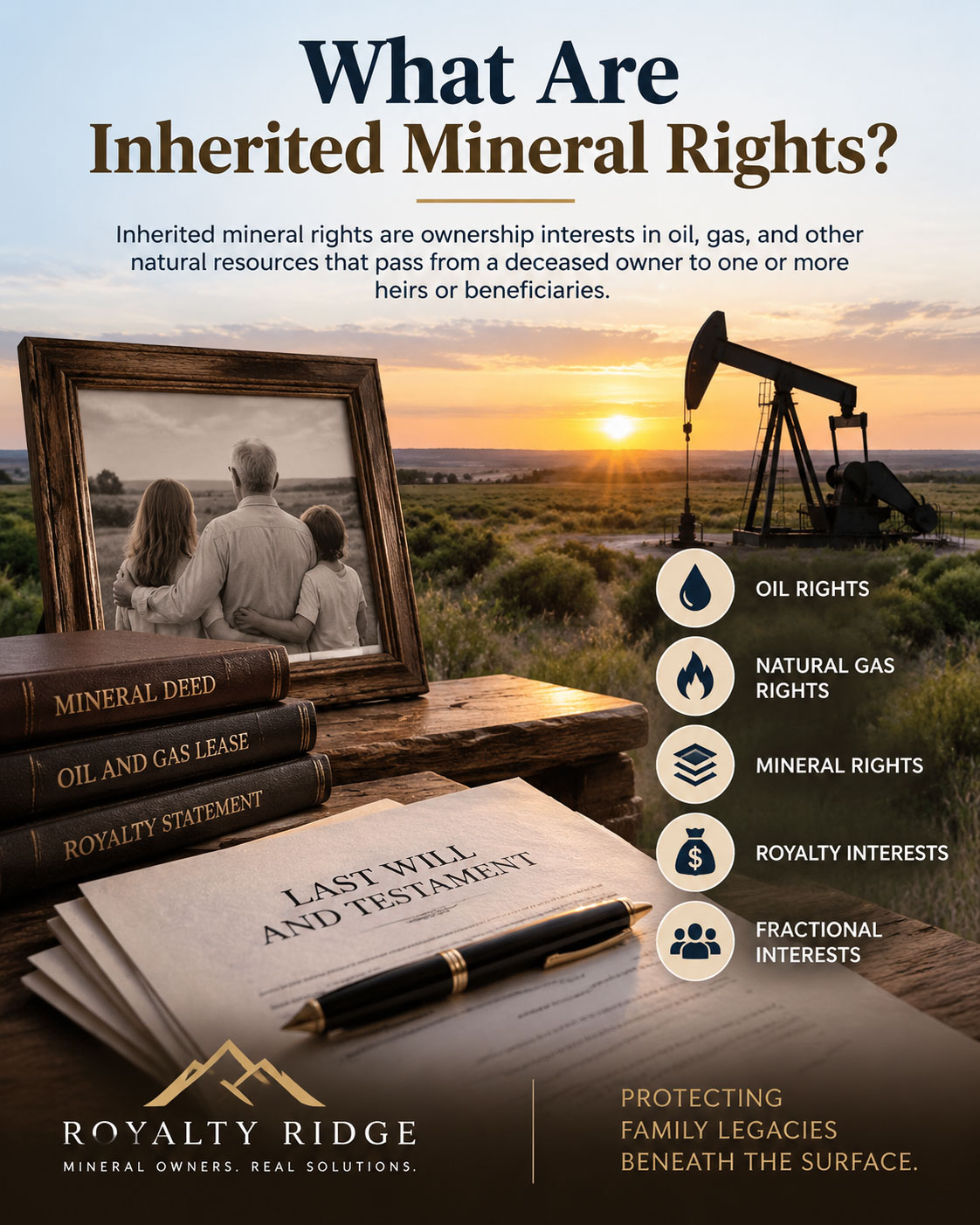
Inherited mineral rights are mineral ownership interests that pass from a deceased owner to one or more heirs or beneficiaries.

Depending on the original ownership documents, the inherited interest may include:

  • Oil rights
  • Natural gas rights
  • Mineral rights
  • Royalty interests
  • Fractional mineral interests
  • Producing interests
  • Non-producing interests
  • Overriding or other royalty interests

The inherited interest may also be located beneath land that you do not own.

This is one reason mineral rights can be confusing for heirs. You can inherit an interest in underground minerals without inheriting ownership of the surface property.

The first step is therefore not selling. It is determining exactly what was inherited.

Find Out What You Inherited

Start by collecting every document you can find relating to the mineral interest.

Look for:

  • Mineral deeds
  • Warranty deeds
  • Oil and gas leases
  • Royalty statements
  • Division orders
  • Probate documents
  • Wills
  • Trust documents
  • Affidavits of heirship
  • Previous mineral deeds
  • Property descriptions
  • Tax records
  • Correspondence from operators

If the deceased owner received royalty payments, old royalty statements can be particularly useful. They may identify the operator, wells, property, ownership percentage, and royalty interest.

You should also identify the state and county where the mineral rights are located.

Determine Who Currently Owns the Mineral Rights

This can be one of the most important parts of an inherited mineral rights transaction.

If one person inherited the entire interest, ownership may be relatively straightforward.

But if several children or grandchildren inherited the interest, each person may own a fractional share.

For example, suppose a parent owned 100% of a mineral interest and left it equally to four children. Depending on the estate documents and applicable law, each child could potentially inherit a 25% interest.

If one of those children later passes away and leaves their interest to their own children, the ownership structure can become even more complicated.

This is why heirs should avoid assuming that they own 100% of an inherited mineral interest simply because the original owner was their parent or grandparent.

A title review can help establish the current ownership.

Check Whether Probate Was Completed

Probate is an important consideration when mineral rights pass through an estate.

The process varies depending on the state, the estate, and the circumstances surrounding the transfer.

If probate was completed, useful records may include:

  • Probate orders
  • Letters testamentary
  • Final orders
  • Wills
  • Estate inventories
  • Distribution documents

If probate was not completed, additional documentation may be needed to establish who inherited the mineral interest.

In some circumstances, an affidavit of heirship or other documentation may be relevant.

Because estate and title laws vary by jurisdiction, complicated inheritance situations should be reviewed with a qualified attorney or title professional.


Determine Whether the Inherited Minerals Are Producing

Next, find out whether the inherited mineral interest currently generates royalty income.

Producing Inherited Mineral Rights

If the minerals are producing, you may receive royalty payments from oil or gas production.

Review recent statements to understand:

  • Monthly or periodic income
  • Producing wells
  • Operator information
  • Ownership percentage
  • Production trends
  • Royalty percentage

Do not assume that today’s royalty check represents a permanent income level.

Oil and gas production can change over time, and individual wells may decline as they mature.

Royalty Ridge notes that production and royalty payments can fluctuate, which is one reason owners may want to understand the current value of an interest rather than relying solely on past income.

Non-Producing Inherited Mineral Rights

An inherited mineral interest may not currently produce income.

That does not necessarily mean it has no value.

A non-producing interest may still be influenced by:

  • Nearby producing wells
  • Drilling activity
  • Leasing activity
  • Permits
  • Operator presence
  • Geological potential
  • Future development

For that reason, non-producing inherited minerals should be evaluated based on the property rather than simply assigned a zero value because there are no current royalty checks.

Get a Professional Mineral Rights Evaluation

Once you have identified the inherited interest, consider getting a property-specific evaluation.

An evaluation can help answer:

  • What do I actually own?
  • Is the interest producing?
  • What wells are associated with the property?
  • What is happening nearby?
  • What factors affect potential value?
  • Should I consider selling all or part of the interest?

Royalty Ridge says its evaluation process includes research into production history, nearby wells, geological factors, market trends, operator history, activity maps, comparable sales, and buyer demand

Decide Whether to Sell All or Part of the Interest

Heirs do not always have to sell an entire inherited mineral interest.

Depending on the ownership structure and transaction, an owner may be able to sell a portion while retaining the remainder.

A partial sale may be considered when an heir wants:

  • Immediate cash
  • To retain some future royalty exposure
  • To divide an interest among family members
  • To simplify part of an estate
  • To diversify assets
  • To reduce exposure to declining production

However, partial sales can create additional ownership considerations, particularly when multiple heirs are involved.


Understand Whether Other Heirs Need to Participate

If multiple people inherited the mineral rights, determining who needs to sign a transaction is essential.

If you own only a fractional interest, you generally should not assume you can transfer another heir’s share.

The exact requirements depend on the ownership documents, state law, title records, and transaction structure.

Before accepting an offer, determine:

  • Who owns the interest
  • Each owner’s percentage
  • Whether ownership is divided
  • Whether all owners are participating
  • Whether an estate or trust is involved
  • Whether additional title documentation is required

For complicated family ownership

Can You Sell Inherited Mineral Rights Without Selling the Land?

In many situations, yes.

Mineral rights and surface rights can be separate interests.

You may inherit or sell mineral rights associated with property that someone else owns at the surface.

Likewise, selling a mineral interest generally does not automatically mean selling the house, ranch, farm, or acreage located above it.

However, the specific documents control the transaction.

Royalty Ridge’s website explains that its transactions concern the mineral interest and that surface ownership remains separate. 

If you are uncertain about what is included in a proposed transfer, have the documents reviewed before signing.

inherited mineral rights, sell inherited mineral rights, inherited oil royalties, inherited mineral rights value, mineral rights buyers, inherited oil and gas royalties, mineral rights evaluation

Why Do Families Sell Inherited Mineral Rights?

Every family has different reasons.

Some heirs prefer a lump-sum payment rather than managing an asset that may generate unpredictable royalty income.

Others may want to:

  • Divide an estate
  • Pay estate-related expenses
  • Fund retirement
  • Pay debt
  • Invest elsewhere
  • Simplify family finances
  • Avoid managing fractional ownership
  • Convert an inherited asset into cash

Royalty Ridge identifies estate planning, retirement, debt, major expenses, unpredictable royalty income, and investment considerations among reasons owners may consider selling. 

selling is not automatically the right choice.

The important thing is understanding the trade-off between receiving money now and retaining potential future income.

inherited mineral rights, sell inherited mineral rights, inherited oil royalties, inherited mineral rights value, mineral rights buyers, inherited oil and gas royalties, mineral rights evaluation

Frequently Asked Questions

Yes, inherited mineral rights can potentially be sold once ownership and the seller’s authority to transfer the interest have been established.

Not necessarily. The answer depends on how ownership is divided and what interest each heir owns. A title review can help determine who owns what.

Depending on the ownership structure and applicable requirements, a fractional owner may be able to sell their own interest without selling another owner’s share.

Value depends on location, ownership percentage, production, lease terms, nearby activity, development potential, and market conditions.

Yes. Non-producing mineral interests may still have value depending on location and future development potential.

Scroll to Top